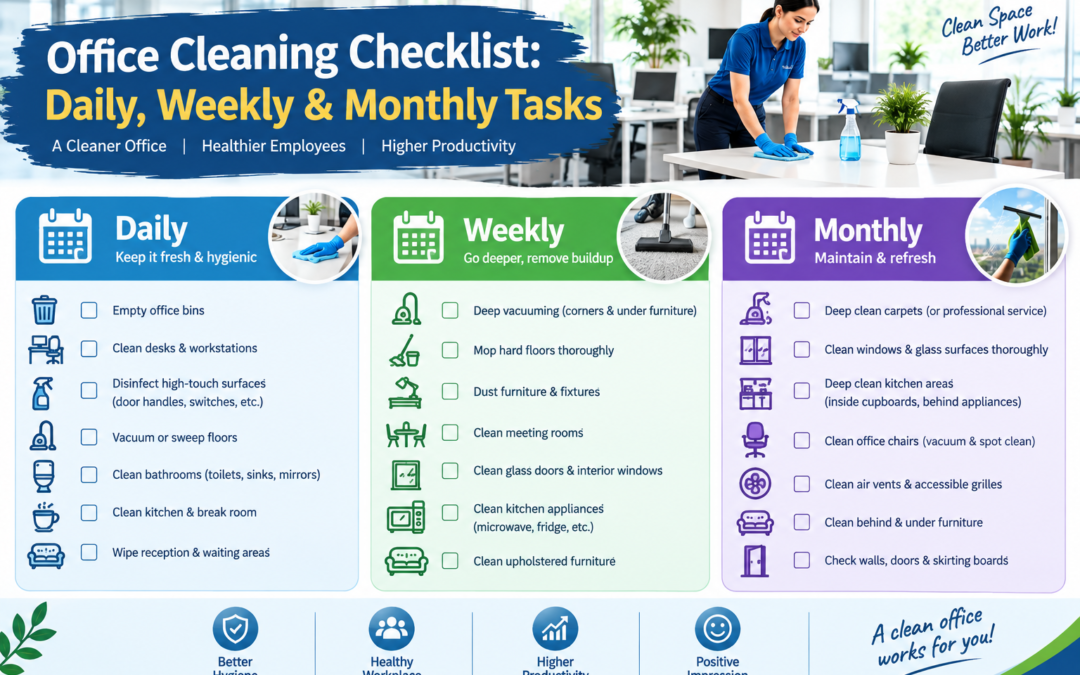
An office that is clean and organized each day creates a nice, comfortable workplace and a pleasant environment for employees, visitors and clients. Therefore, Developing a consistent plan for cleaning an office is important, as different spaces have different needs. In some cases, cleaning a space may be as frequent as each day, while some tasks may need to be cleaned once a week or once a month.
For example, Creating an office cleaning checklist outlines the requirements for cleaning a workplace. This type of checklist helps direct cleaning staff, and employees, with the tasks to perform as well as the timing for each task. From the daily cleaning of desks and emptying of office bins to cleaning of carpets, windows, kitchens, restrooms and common areas, such a schedule helps ensure all of the important tasks are completed.
Moreover, office staff should maintain the office on a daily, weekly and monthly basis. Daily office cleaning is focused on visible dirt and high-traffic areas. Weekly office cleaning helps with more detailed maintenance, while monthly cleaning helps to focus on less frequent detailed tasks and general area cleaning.
Finally, Regardless of the size of the property you manage, whether a small workplace or a large commercial space, this guide will help you understand how to create a simple daily, weekly and monthly checklist to facilitate a clean and organized work space.
Why Is an Office Cleaning Checklist Important?
Furthermore, any office environment without a cleaning schedule risks neglecting some areas, while creating a consistent cleaning routine through a checklist ensures all areas are cleaned.
Furthermore,. a standardized cleaning checklist can help with:
- Cleaning high-traffic areas
- Controlling dust build-up
- Maintaining workplace hygiene
- Keeping bathrooms and kitchens clean and fresh
- Improving the workplace
- Defining cleaning roles and task allocation
- Ensuring that necessary tasks are not overlooked
- Scheduling regular cleaning maintenance
- Building a safe and comfortable workplace for all employees and customers
Moreover, managers are also able to use checklists as a means for verifying that cleaning tasks are being done correctly.
In addition, For larger offices, professional commercial office cleaning can help standardize cleanliness across larger areas.
Daily Office Cleaning Checklist
Firstly, Cleaning frequency should prioritize areas most used by employees and customers. As a result, These areas get dusty and dirty quicker.
For example Office daily cleaning checklist:
Vacuum office bins
In addition, to avoid bad smells and to keep areas clean, empty bins in kitchens, bathrooms, meeting, and high traffic areas.
Moreover, routine cleaning of office waste improves:
- Office cleanliness
- The appearance of the office
Clean desks and workstations
Moreover, Fingerprints, chunks and bits of food, dust, and debris accumulate on surfaces during the workday. Cleaning and disinfecting surfaces should be a priority for all cleaning personnel.
In addition, Cleaning products should not be sprayed or misted onto work or personal electronic devices.
Clean High Touch Surfaces
Furthermore, Door handles, light switches, and elevator buttons are some of the surfaces that require disinfection and cleaning during office sanitation.
For example, Some other examples are:
- Handrails
- Printer buttons
- Cabinet handles
- Meeting-room tables
- Kitchen appliances
These surfaces become some of the main contributors to poor workplace hygiene if not cleaned.
Vacuum or Sweep Floors
Similarly, Dirty floors are the fastest ways to showcase an unkempt, dusty and messy workplace through foot traffic.
Pay special attention to:
- Entrances
- Hallways
- Reception
- Break Rooms
- Under Desks
- High-traffic walkways
Therefore, Cleaning staff should clean floors regularly so dirt does not spread to other areas of the workplace.
Clean Office Bathrooms
Firstly, Bathrooms need to be cleaned every day.
In addition, Bathroom cleaning often consist of:
- Toilet cleaning
- Sink cleaning
- Mopping floors
- Cleaning taps
- Cleaning mirrors
- Emptying bins
- Restocking toilet paper
- Restocking soap
Moreover, Checking paper towels or hand-drying facilities
Therefore, Clean bathrooms are a critical element to have a clean and professional workplace.
6. Clean the Office Kitchen and Break Room
Similarly, Eating, drinking and food preparation in these areas leads to mess and increased dirt.
For example, Cleaning the Kitchen may include:
- Wiping counter tops
- Cleaning sinks
- Cleaning tables
- Cleaning surfaces
- Removing food waste
- Emptying bins
- Sweeping or moping floors
- Checking refrigerators for spills
Finally, Employees are expected to create a clean workplace by cleaning after themselves.
7. Clean Reception and Waiting Areas
First, Reception areas are the first spaces clients see when they visit your business. Therefore, an unclean space with dirty bins can lead to a bad first client impression.
In addition, Daily clean can include the following:
- Dusting of furniture
- Vacuum/sweep of floor
- Cleaning of tables
- Emptying of bins
- Removal of visible marks
- Re-positioning of chairs
Moreover, cleaning of surfaces that are in constant contact with clients
As a result, reception cleanliness should be prioritized when clients visit your business often.
Weekly Cleaning Checklist
Even with daily cleaning, some tasks need to be done with more time and attention. Therefore, Weekly cleaning takes up the slack for these tasks.
Deep Cleaning of Carpeted Areas
In addition, Deep vacuuming of carpets helps clean carpets, including some harder to reach areas.
In addition, Cleaning teams should pay attention to the following:
- Carpeted edges
- Carpeted corners
- Areas between furniture
- Areas behind furniture
- Meeting rooms
- Less frequently used areas of the office
- The hallways
Moreover, cleaners may have an easier time cleaning some of these sections if the furniture in these areas is movable.
For example, If your office has heavily used carpets, a regular professional carpet cleaning may be needed. You can read our Carpet Cleaning Melbourne Guide for more information on how to keep your carpeted areas looking their best.
Thoroughly Clean Hard Surface Floors
Similarly, Hard surface floors need more detailed clean each week.
For this reason, weekly cleaning of hard surface floors can include the following:
- Removal of stubborn marks
- Mopping of corners
- Cleaning of area surrounding furniture
- Cleaning of build up
- Checking for signs of spills or stains
Finally, a cleaning product appropriate for the hard surface floor is always necessary.
Dust Furniture and Fixtures
However, dust can settle in areas that are usually not wiped.
Weekly Dusting
- Shelves
- Filing cabinets
- Decorative Items
- Furniture Edges
- Picture Frames
- Windowsills
Dust Build up is less noticeable when you do weekly dusting.
This makes the rest of the office look cleaner.
Clean Meeting Rooms
For example, Meeting rooms should get a more thorough cleaning each week. This can include:
- Cleaning tables
- Wiping chairs
- Cleaning whiteboards
- Vacuuming
- Dusting furniture
- Cleaning high touch surfaces
- Emptying bins
- Checking presentation equipment
A clean meeting room creates a more pleasant experience for employees as well as for people attending a meeting and for visitors.
Clean Glass Doors and Interior Windows
Finally, Glass doors and windows can get lots of smudges and fingerprints.
This weekly cleaning should include:
- Glass doors
- Interior windows
- Glass partitions
- Reception glass
- Meeting room doors
For larger buildings, it may require professional window cleaning for exterior windows or windows that are difficult to reach.
Clean Kitchen Appliances
The kitchen may need an additional large cleaning at least once per week.
Depending upon workplace policies, weekly tasks may consist of:
- Cleaning the microwave
- Wiping the refrigerator shelves
- Cleaning the outside of the coffee maker
- Cleaning the fronts of the cabinets
- Wiping the appliance handles
- Cleaning the splashback
- Removing caked on food
Food left out should be covered, and old food should be thrown out according to the office kitchen policy.
Clean Upholstered Office Furniture
Office chairs and sofas collect dust, food, and stains.
Weekly vacuuming may be necessary. Upholstery should be cleaned on a routine basis as well based on use.
For workplaces that have sofas or fabric chairs in the reception area, you can also look at our Upholstery Cleaning Wollert Guide for more information on upholstery.
Monthly Office Cleaning Checklist
Monthly office cleaning includes tasks that are overlooked in everyday cleaning.
Deep Clean Carpets
Carpets collect dirt in the fibers and even with daily vacuuming, dirt can become embedded.
A monthly inspection would determine the level of cleaning required for carpets.
Signs of neglect may include:
- Visible stains
- Flattened areas from traffic
- Unpleasant odors
- Dirt around entrances
Clean Windows and All Glass Thoroughly
A more thorough cleaning of windows and glass surfaces can be done monthly.
This may include:
- Window frames
- Window sills
- Glass room dividers
- All interior glass
- Hard to reach areas
If your office has exterior windows, it may be worth the cost to hire window cleaners.
Deep Clean Kitchens
A deep clean of kitchens done monthly may include tasks that are normally done daily such as:
- Cleaning inside cabinets
- Cleaning behind appliances
- Deep cleaning of sinks
- Cleaning the inside of refrigerators
- Removing buildup on surfaces
- Cleaning walls and splashbacks
- Checking for potential issues
A deep cleaned kitchen can set a better tone for employees at work.
Deep Clean Office Chairs
Office chairs may collect over 100 work hours and may need a deep clean by the end of the year due to dirt buildup and body oils.
A monthly inspection will determine the level of cleaning required.
Clean Accessible Air Vents and Grilles
Cleans these areas to remove dust accumulation.
Per building maintenance plan, cleaning of easy access vents and grilles is required.
Internal maintenance work of an HVAC system must only be performed by applicable technicians and must not be assigned to cleaning staff.
Clean Behind and Under Furniture
The areas behind cabinets, desks, and units get neglected duringsurface cleaning.
Routine cleaning of units should include moving furniture units to clean:
- Dust
- Hair
- Paper scraps
- Food particles
- Dirt
This could improve appearance in low-visibility areas.
Check Walls, Doors and Skirting Boards
Walls and doors accumulate scuffs and marks over time.
Routine cleanliness should include the spot cleaning of walls, doorframe cleaning, wiping doors and skirting boards
as well as removal of marks.
Always use cleaning products appropriate for the surface you are cleaning.
Office Cleaning Checklist by Frequency
Cleaning Task Daily Weekly Monthly
Empty bins. ✓ ✓ ✓
Desk cleaning. ✓. ✓ ✓
High-touch surfaces ✓ ✓ ✓
Bathroom cleaning ✓. ✓ ✓
✓
Kitchen cleaning ✓. ✓
Vacuum floors ✓. ✓ ✓
Deep carpet cleaning
✓
Window cleaning
✓ ✓
Furniture deep cleaning
✓
Clean behind furniture
✓
Deep kitchen cleaning
✓
Clean skirting boards
✓
The extent of cleaning should be based on the size of the office, number of employees, level of activity, type of
business, and specifics of building.
Office Cleaning Checklist for Different Areas
Not every area of an office requires the same cleaning frequency.
Reception Area
Highlight:
- Floor
- Desks
- Reception
- Glass
- High-touch
- Bins
Workstations
Highlight:
- Floors
- Desks
- Chairs
- Shared equipment
- High-touch surfaces
Kitchen
Highlight:
- Floors
- Counters
- Sinks
- Appliances
- Tables
- Food waste
Bathrooms
Highlight:
- Floors
- Sinks
- Toilets
- Touchpoints
- Mirrors
- Supplies
Meeting Rooms
Highlight:
- Tables
- Chairs
- Floors
- Whiteboards
- Door handles
- Bins
A checklist that is well organized helps direct the appropriate amount of time for each area.
Benefits of Office Cleaning Services
An internal checklist might be useful for staff to manage routine cleaning, but most businesses choose to hire office cleaning services to manage larger and more extensive workplaces.
Office cleaning services provide:
Standardized Cleanliness
With scheduled cleanings, standards are easy to keep.
performs tasks
Cleaning technicians use special equipment designed for each surface of the workplace, including carpets, floors, upholstery, windows, etc.
Time Save
Cleaning services tend to be cost-effective. Employees can focus on their responsibilities, while cleaning services tend to the workplace.
Cleanings
A standard cleaning will meet the needs of most businesses. For deeper cleanings, services provide an extra cleaning beyond the normal schedule.
Flexibility
Cleanings can easily be arranged to occur before or after normal business hours in order to pose minimal interruption to normal business activities.
Better health and an organized workplace can be achieved by employing office cleaning services. Our guide on Professional Office Cleaning Services elaborates more on the benefits of commercial cleaning.
How to Create an Effective Office Cleaning Schedule
Making a cleaning schedule doesn’t have to be difficult.
Start by listing every important area in your office. Now, separate tasks into daily, weekly, and monthly jobs.
Step 1: Which areas are the most used?
Examples are hallways, restrooms, and break rooms, as well as, common work spaces.
Step 2: What tasks get done?
Task ideas to make this list include vacuuming, dusting, sweeping, surface sanitizers, bathroom clean, empty trash, etc.
Step 3: What tasks get done by who?
Figuring out what each person is responsible for each task. You could use employees, internal staff, or service contracts.
Step 4: How often?
Tasks will be daily, weekly, or monthly.
Step 5: How often does cleaning occur?
What the cleaning staff schedule is for the office.
Some common and simple mistakes to avoid when cleaning an office.
Using a cleaning schedule can help eliminate mistakes. For cleaning schedules to be effective, all surfaces need to be cleaned.
Ignoring High-Touch Surfaces
There are several surfaces around an office that get touched more than others, like light switches and door handles, or work equipment.
Limiting Yourself to Surface Level Cleaning
Dust and dirt can accumulate underneath furniture, in corners, and in back places.
Using Incorrect Cleaning Products
Not all surfaces are the same and require different cleaning products. Check the cleaning product label to see if manufacturer directions exist.
Not Cleaning Cleaning Equipment
Mops, dust cloths, filters, and vacuum cleaner bags, and bags themselves, require cleaning and maintenance.
Not Developing a Cleaning Routine
Neglecting to develop office cleaning routine evenly distributes the appearance of a clean office while some areas are neglected.
Final Thoughts
A well-developed cleaning schedule helps organize everyday office cleaning. Emphasis should be placed on cleaning high-traffic areas such as workspaces, bathrooms, and kitchens on a daily basis; while high-touch surfaces should be prioritized daily.
Weekly office cleanings are able to focus on carpet, furniture, glass surfaces, meeting room, appliances, and an overall better detail to the office cleaning. Monthly cleanings can be used to fully maintain carpet, complete detail cleaning of the kitchen and behind furniture, cleaning of upholstery, vents and doors, and cleaning of base boards.
Cleaning office spaces depends on the size, number of employees, foot traffic, nature of your business, and your specific cleaning preferences.
For most businesses, the most effective way to have an office cleaned is to employ a structured cleaning list and a professional cleaning service. Leaving time between cleanings ensures dirt does not build up and becoming an issue, while letting professional cleaners is more effective when intended for more intensive cleaning.
Having a cleaning schedule keeps a business’s office looking polished and more welcoming. A cleaning schedule allows businesses to manage their office cleaning so that it is a major aspect of their routine and not an occasional chore.
Frequently Asked Questions
What should be included in a daily office cleaning checklist?
emptying of bins, desk surface cleaning, bathroom cleaning, cleaning of high touch surface areas, sweeping/vacuuming of the floor, kitchen area cleaning, and orderliness of reception and other shared areas should be included in a daily checklist.
What office cleaning tasks should be done weekly?
Cleaning of upholstery, glass doors, kitchen appliances, meeting rooms, dowry cleaning, detailed cleaning of the kitchen, detailed vacuuming and mopping of floors, furniture and fixture cleaning should all be included in a weekly checklist.
What are the main elements of an office cleaning service contract?
An office cleaning service contract may include carpet cleaning, deep clean of kitchens, cleaning of windows and glass, cleaning of space behind and underneath office equipment, cleaning of furniture upholstery, cleaning of accessible vents and skirting boards.
How often should an office be professionally cleaned?
The frequency of cleaning required would depend on the size and nature of the business. For example, a small business may only require monthly cleaning, however, a large business that has a high level of employee interaction and/or customer, or client, interaction may require daily professional cleaning.
What would be the key benefits of a scheduled office cleaning service?
A regular cleaning service will control dirt, dust, spills and general build up. A clean working area will give a more professional appearance and will help increase employee satisfaction.
Will an employer instruct employees to assist with the company office cleaning?
Yes, an employer will expect employees to assist with general office cleaning. This will include keeping your work area cleaned, disposal of waste and general cleaning of common use kitchens.
What within an office will require the greatest level of cleaning?
The areas which will require the greatest level of cleaning will be those which are most heavily utilized and most frequently in contact with employees. These areas will include common areas and employee use meeting rooms, the main business entry, bathrooms, kitchens, reception and all main business thoroughfares.
How valuable would professional cleaning service be to a business?
A professional cleaning service may be necessary to a business that requires cleaning on a daily basis, has special needs equipment and/or request more intensive cleaning.
How may an employer encourage an overall cleaner environment in between professional cleaning visits?
Reinforce to employees the importance of cleaning up spills and disposing waste. General cleanup of all work areas and common use kitchens is an employee responsibility. Vacuuming and general surface cleaning is a simple way to pass the time until the next scheduled cleaning.
What is the difference between routine/regular cleaning and deep/periodic cleaning in an office?
With routine/regular cleaning, high-touch surfaces, desks, bathrooms, and waste receptacles are emptied. Deep or periodic cleaning focuses on more detailed cleaning of areas such as carpet and upholstery, window cleaning, kitchens, and moving everything to enable complete cleaning in the hard-to-clean areas.